
University of Gothenburg
Associate Professor
Department of Political Science
agnes.cornell@pol.gu.se Google Scholar @cornell_agnes LinkedIn
University of Gothenburg
Department of Political Science
About
I am an Associate Professor at the Department of Political Science, University of Gothenburg.
My research lies at the intersection of public administration and comparative politics, and centers on three themes. The first concerns the relationship between citizens and the state — how citizens interact with public institutions and their representatives, and what shapes citizens' compliance and trust in the state. The second concerns bureaucracy, both its historical development and its contemporary role in governance. The third concerns the conditions for democratic stability, including the effects of foreign aid on democratization.
My work has been published in journals such as the Journal of Politics, Comparative Political Studies, Governance, and the European Journal of Political Research.
I am co-author of Democratic Stability in an Age of Crisis: Reassessing the Interwar Period (Oxford University Press, 2020, with Jørgen Møller and Svend-Erik Skaaning).
I serve as Director of Studies for the Master's Programmes in Political Science and the Master's Programme in International Administration and Global Governance (IAGG) at the University of Gothenburg.
Research
01
Examining the development of bureaucracy over time — from the historical origins of meritocratic recruitment and administrative reform, to how contemporary bureaucratic structures affect policy implementation, economic growth, political accountability, and democratic quality.
02
Investigating how citizens interact with public institutions and their representatives — what shapes trust and compliance, how frontline bureaucrats affect citizen behaviour, and how civil society organisations navigate their relationship with the state.
03
Studying the conditions under which democracies survive or break down, drawing on comparative and historical evidence.
Ongoing Research Projects
This project examines citizen–state relations and voluntary compliance in Sweden. High-capacity states depend on citizens' willingness to comply with state policy, yet Sweden has received many citizens from countries where the state exercises power through coercion. The project uses Swedish register data to study compliance patterns, and tests how different background characteristics, such as country of origin, affect citizens' willingness to engage with the state.
Unlawful influence — including threats, harassment, and corruption — poses serious challenges to local government in Sweden. This project investigates how common such attempts are against frontline bureaucrats in municipalities, and whether social ties make them more vulnerable or more resilient. Combining register data, surveys, and interviews, the project generates new knowledge on how unlawful influence operates and how it can be prevented.
Civil society organisations are often seen as democracy's watchdog — defending rights and holding governments to account. Yet evidence from third-wave democracies also shows that civil society can engage in clientelism, trading political support for targeted benefits. This project examines when and why civil society organisations act in the public interest versus engaging in clientelistic exchanges. It uses surveys with embedded experiments on civil society leaders in Peru, and a field experiment, to shed new light on this dynamic.
Publications
Book
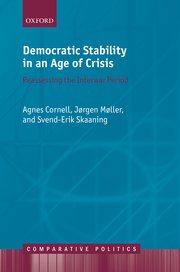
Democratic Stability in an Age of Crisis: Reassessing the Interwar Period
A comprehensive reassessment of democratic breakdown and survival during the interwar years (1918–1939). Using a combination of comparative-historical analysis and quantitative methods, the book challenges common analogies with contemporary democratic backsliding and offers new insights into the conditions that made democracies resilient or fragile during a turbulent era.
View at Oxford University Press →Peer-reviewed articles
Devolution and Corruption in Kenya: Everyone's Turn to Eat?
Citizen–State RelationsWhy Bureaucratic Stability Matters for the Implementation of Democratic Governance Programs
BureaucracyPlus Ça Change? County-Level Politics in Kenya after Devolution
Citizen–State RelationsDoes Regime Type Matter for the Impact of Democracy Aid on Democracy?
Democratic StabilityOther research articles
The Real Lessons of the Interwar Years
Democratic StabilityFor book chapters, reports, and working papers, see Google Scholar.
Work in Progress
Citizen–State Relations
Ancestral Institutions and Participation in Interventions for Children's Welfare among Immigrants in Sweden
Does Disinformation Diminish Compliance with the State? Evidence from the 2021 LVU-Campaign in Sweden
The Effects of Institutional Knowledge on Accountability Actions: Experimental Evidence from Civil Society Leaders in Peru
Institutional Determinants of Civil Society Organizations' Demands and Tactics: Experimental Evidence from Peru
Bureaucracy
From Patronage to Merit: The Transformation of Bureaucratic Recruitment in 19th Century Britain
Does Linguistic Identity Matter? Bureaucrat Background and Citizen Evaluations in the Basque Country
Democratic Stability
Representation in Divided Societies: Political Preferences in the Basque Country
Attitudes towards Political Violence in the Basque Country
Teaching
I serve as Director of Studies for three master's programmes at the Department of Political Science, University of Gothenburg. In this role I am, among other things, responsible for the academic coordination and development of the programmes and admissions.
I also teach at the doctoral level. My current doctoral course is The Political Economy of Democratization.